Afternoon Slump at Work: What Actually Wakes You Up
Why you crash at 2–3 p.m. at your desk and what helps: a lighter lunch, a 5-minute walk, daylight, coffee timed for sleep, a short nap. What the evidence says.
On this page
It's 14:30, you've read the same Jira ticket three times, and your eyelids weigh a ton. The afternoon slump is mostly your body clock: in mid-afternoon the signals that keep you awake dip while sleep pressure keeps building 1. You can't cancel it, but you can shrink it: a lighter lunch, a five-minute walk, coffee before mid-afternoon and, if possible, a nap under 20 minutes 241114.
It isn't only the lunch
NIOSH, the US workplace health agency, blames the body clock, not food 1. In one small simulator trial, sleepy drivers drifted out of lane most in mid-afternoon 9.
Lunch can make it worse, though. In a meta-analysis of 31 studies, carbohydrates left people more tired and less alert within the first hour 2.
In another small trial, 12 young men who had slept 5 hours drove a simulator after a 305 or a 922 kcal lunch. After the heavy one they drifted out of lane more 3. One study: treat it as a hint.
Our approach: protein and vegetables, and the pastry stays in the shop. More in Healthy desk snacks.
Five minutes of walking
In one randomised crossover trial, 30 inactive adults sat for 6 hours. A 5-minute walk every hour raised energy, lowered fatigue and even cut food cravings versus nonstop sitting 4. A micro-break meta-analysis found a small lift in vigour and less fatigue, but no real change in performance 5.
You'll feel fresher, though your to-do list won't halve itself (see Exercise snacks). Grab water on the way. Dehydration mostly hurts attention past a 2% water loss, more than a usual office day 15, so thirst is a fine guide (How much water at work?).
Daylight helps a little
In a 68-study review, brighter light usually made people feel more alert, though many studies found nothing and reaction times rarely improved 6. Another review says moderately bright light probably reduces daytime sleepiness, but on few, mostly lab studies 7. Still, a walk outside on a sunny day costs nothing.
Coffee: dose and timing
Caffeine works: in a meta-analysis of 45 publications it sharpened attention and reaction time in people short on sleep 8. In the simulator trial, 200 mg shrank the afternoon sleepiness peak 9.
Caffeine cut sleep by about 45 minutes in another meta-analysis, which advised a regular coffee (about 107 mg) at least 8.8 hours before bed 11. Bed at 23:00? Last cup around 14:00. EFSA adds that even 100 mg near bedtime can disturb sleep 10.
EFSA's limits for healthy adults: 400 mg a day, 200 mg at once; in pregnancy and breastfeeding, 200 mg a day 10. The NHS agrees for pregnancy and counts about 100 mg in a cup of instant coffee 12.
A short nap, if you can
A meta-analysis of 11 small, mostly lab studies found afternoon naps improved alertness 13. NIOSH suggests under 20 minutes with an alarm at 15–30 minutes, to avoid deep sleep and grogginess 14. Coffee right before the nap worked even better in that one small driving trial 9.
Three moves for the slump
About 3 minutes by your desk.
March in place
- Starting position: stand tall, feet hip-width apart, elbows bent.
- Action: march briskly, knees to mid-thigh, arms swinging.
- Result: your pulse picks up and your head clears.
- Safety: start with 30 seconds, add 15 a week, up to 2 minutes. Skip it with a fresh ankle or knee injury; hold the desk if unsteady.
Chair sit-to-stand
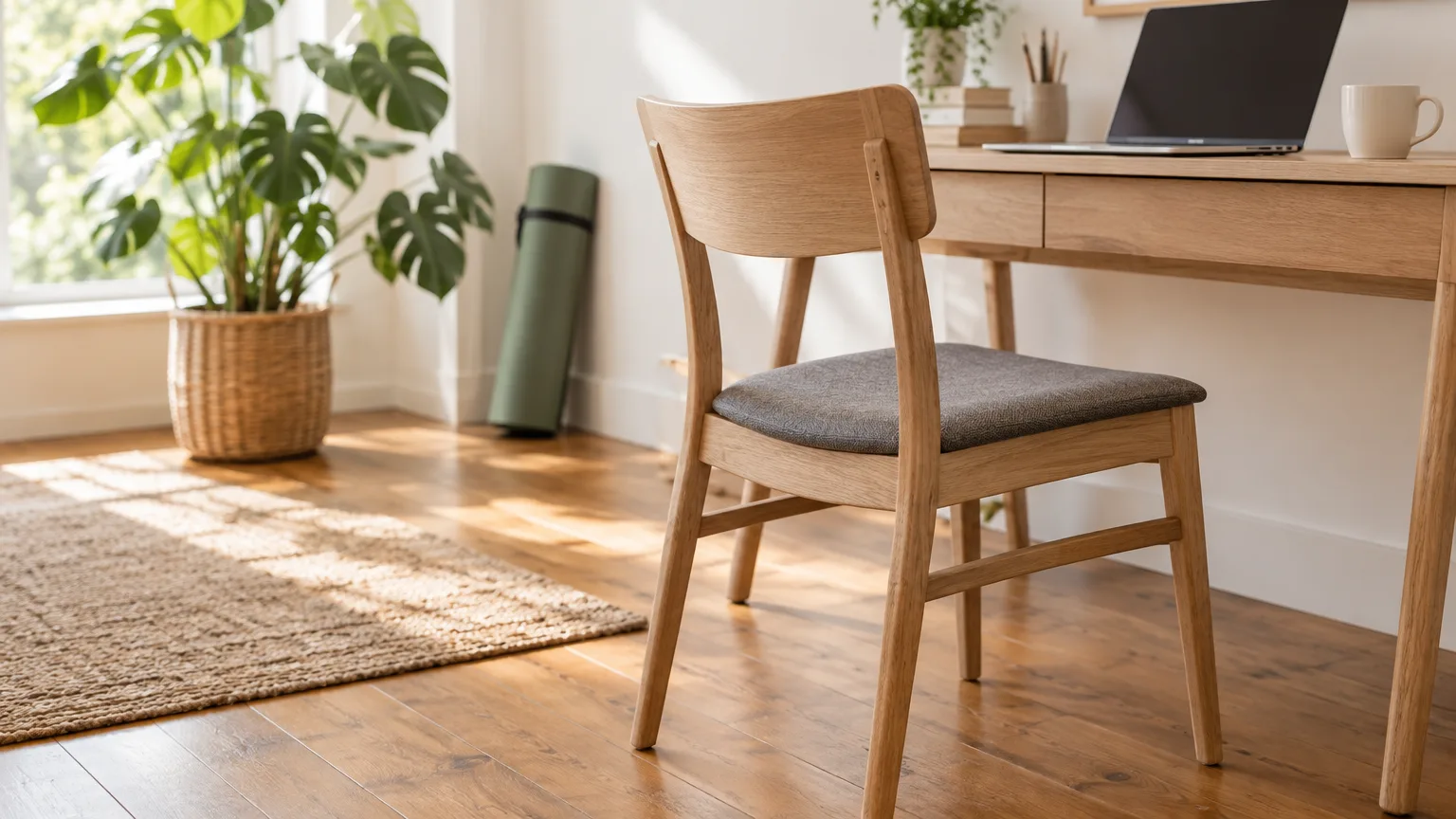
- Starting position: sit on the edge of a stable chair without wheels, feet flat.
- Action: lean forward, stand up, then sit down slowly over 3 seconds. Do 5 reps.
- Result: your legs wake up and you breathe deeper.
- Safety: add 2 reps a week, up to 15; use the armrests if needed. Skip it if your knees or hips hurt.
Standing stretch
- Starting position: stand tall, arms down.
- Action: reach your arms overhead for 10–15 seconds, breathing calmly. Repeat 3 times.
- Result: you straighten out of the after-lunch hunch.
- Safety: with a sore shoulder, raise your arms only as far as is comfortable.
Stop at once if you feel chest pain, dizziness or unusual breathlessness.
When to see a doctor
A dip after lunch is normal. These aren't:
- Tiredness for weeks without a clear reason 17.
- Loud snoring, gasping or choking at night, or someone noticing you stop breathing 16.
- Nodding off at the wheel. Stop driving until it's checked; in the UK some sleep conditions must be reported to the DVLA 19.
- Tiredness with pale skin, palpitations or breathlessness (possible anaemia), or with thirst, peeing more and weight loss (possible diabetes) 17.
- Tiredness with feeling cold, weight gain and constipation (possible underactive thyroid) 18.
Up you get
Stand up and march for 30 seconds right now. Tomorrow, let WeaveMove nudge you before the slump arrives.
FAQ
Why do I get so sleepy after lunch?
Mostly your body clock 1. A big, carb-heavy lunch can deepen the dip 23.
What's the latest time to drink coffee?
About 9 hours before bed for a regular cup 11.
Is a nap at work a good idea?
If you can lie down, yes: under 20 minutes, with an alarm 1314.
Sources
- NIOSH (CDC). Training for Nurses on Shift Work and Long Work Hours. Module 2: Afternoon Dip in Wakefulness. https://www.cdc.gov/niosh/work-hour-training-for-nurses/longhours/mod2/21.html
- Mantantzis K, Schlaghecken F, Sünram-Lea SI, Maylor EA. Sugar rush or sugar crash? A meta-analysis of carbohydrate effects on mood. Neurosci Biobehav Rev. 2019;101:45–67. https://doi.org/10.1016/j.neubiorev.2019.03.016
- Reyner LA, Wells SJ, Mortlock V, Horne JA. 'Post-lunch' sleepiness during prolonged, monotonous driving: effects of meal size. Physiol Behav. 2012;105(4):1088–1091. https://pubmed.ncbi.nlm.nih.gov/22155490/
- Bergouignan A, Legget KT, De Jong N, et al. Effect of frequent interruptions of prolonged sitting on self-perceived levels of energy, mood, food cravings and cognitive function. Int J Behav Nutr Phys Act. 2016;13:113. https://doi.org/10.1186/s12966-016-0437-z
- Albulescu P, Macsinga I, Rusu A, Sulea C, Bodnaru A, Tulbure BT. "Give me a break!" A systematic review and meta-analysis on the efficacy of micro-breaks for increasing well-being and performance. PLoS ONE. 2022;17(8):e0272460. https://doi.org/10.1371/journal.pone.0272460
- Souman JL, Tinga AM, te Pas SF, van Ee R, Vlaskamp BNS. Acute alerting effects of light: a systematic literature review. Behav Brain Res. 2018;337:228–239. https://doi.org/10.1016/j.bbr.2017.09.016
- Xu Q, Lang CP. Revisiting the alerting effect of light: a systematic review. Sleep Med Rev. 2018. https://doi.org/10.1016/j.smrv.2017.12.001
- Irwin C, Khalesi S, Desbrow B, McCartney D. Effects of acute caffeine consumption following sleep loss on cognitive, physical, occupational and driving performance: a systematic review and meta-analysis. Neurosci Biobehav Rev. 2019. https://research-repository.griffith.edu.au/items/2a8009a3-009d-4d46-b792-bb4c9d34c45d
- Reyner LA, Horne JA. Suppression of sleepiness in drivers: combination of caffeine with a short nap. Psychophysiology. 1997;34(6):721–725. https://pubmed.ncbi.nlm.nih.gov/9401427/
- EFSA. Caffeine (topic page summarising the Scientific Opinion on the safety of caffeine, EFSA Journal 2015;13(5):4102, https://doi.org/10.2903/j.efsa.2015.4102). https://www.efsa.europa.eu/en/topics/topic/caffeine
- Gardiner C, Weakley J, Burke LM, et al. The effect of caffeine on subsequent sleep: a systematic review and meta-analysis. Sleep Med Rev. 2023;69:101764. https://doi.org/10.1016/j.smrv.2023.101764
- NHS. Foods to avoid in pregnancy (caffeine). https://www.nhs.uk/pregnancy/keeping-well/foods-to-avoid/
- Dutheil F, Danini B, Bagheri R, et al. Effects of a short daytime nap on the cognitive performance: a systematic review and meta-analysis. Int J Environ Res Public Health. 2021;18(19):10212. https://doi.org/10.3390/ijerph181910212
- NIOSH (CDC). Training for Nurses on Shift Work and Long Work Hours. Module 7: Napping, Nap Duration. https://www.cdc.gov/niosh/work-hour-training-for-nurses/longhours/mod7/05.html
- Wittbrodt MT, Millard-Stafford M. Dehydration impairs cognitive performance: a meta-analysis. Med Sci Sports Exerc. 2018;50(11):2360. https://doi.org/10.1249/MSS.0000000000001682
- NHS. Sleep apnoea. https://www.nhs.uk/conditions/sleep-apnoea/
- NHS. Tiredness and fatigue. https://www.nhs.uk/conditions/tiredness-and-fatigue/
- NHS. Underactive thyroid (hypothyroidism). https://www.nhs.uk/conditions/underactive-thyroid-hypothyroidism/
- GOV.UK. Excessive sleepiness and driving. https://www.gov.uk/excessive-sleepiness-and-driving
Comments
No comments yet. Be the first to share your experience.