
Chair Exercises: 5 Moves for When You Can't Stand Up
Stuck in your seat on a call, in an open-plan office or with a sore knee? Five chair exercises for neck, back and hips, with doses, safety tips and evidence.
On this page
Fourth call of the day, camera on, or a sore knee that makes standing a chore. You can still move: five slow chair exercises for the neck, back and hips break up the stillness and wake the muscles that hold you upright. WHO says any activity instead of sitting, even light, benefits health 1. Standing up and walking is usually the stronger break 2, so treat the chair set as a plan B you can do anywhere.
What moving in your chair can and can't do
Movement breaks lower blood sugar and insulin after meals, a review pooling 37 studies found 3. But those breaks were mostly walking, and another review found light walking beat just standing 2. Seated moves weren't tested, so no promises there.
Pain is a different story. In a 6-month trial, regular breaks out of the chair cut new neck pain to 17%, versus 44% without them 4. A seat cushion that nudged people to shift position while sitting worked about as well. One trial only, but moving in your chair seems to beat sitting frozen.
For the neck, strength beats stretching: two reviews found strengthening eases neck pain, while stretching alone may do little 56. So the set has a strength move.
Five moves without getting up
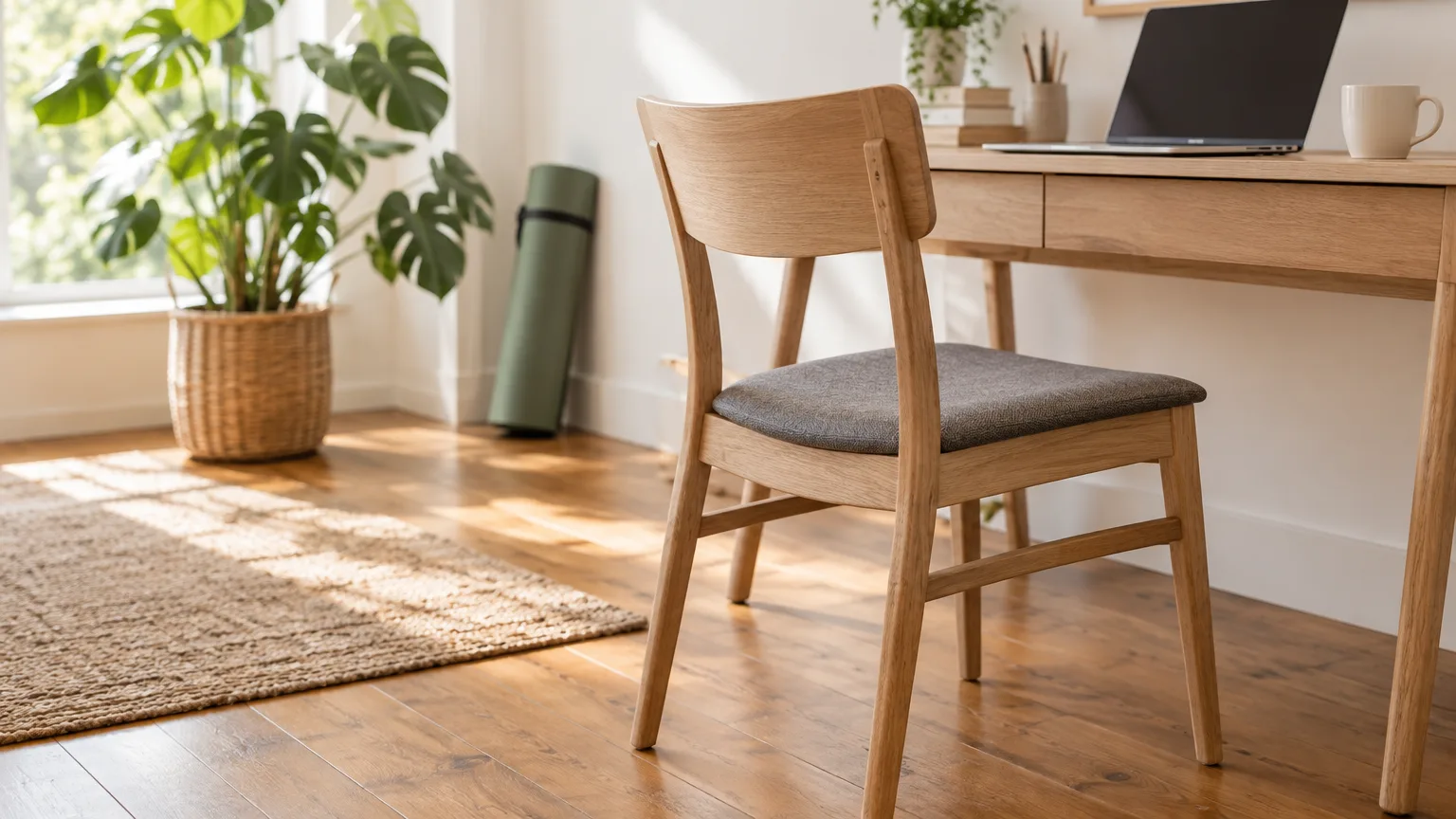
Use a stable chair without wheels, feet flat on the floor 7. Move slowly, within comfort. Sharp, shooting or spreading pain means stop.
1. Chin tucks
- Starting position: sit tall, shoulders down, eyes forward.
- Action: draw your head straight back into a double chin, without nodding. Hold 5 seconds.
- Result: light work at the front of the neck, a stretch at the base of the skull.
- Safety: 5 reps, build to 10 over two weeks. Skip after a recent neck injury; stop if dizzy or your arm tingles.
2. Self-resisted shrugs
- Starting position: sit straight, hands holding the seat at your sides.
- Action: over 2–3 seconds, lift your shoulders toward your ears while your arms pull you down into the seat. Lower just as slowly.
- Result: quiet strength work for the shoulders and upper back.
- Safety: 6–8 reps, up to 10–12. Keep the neck long. Skip with a shoulder injury; stop if it hurts.
3. Thoracic extension over the chair back
- Starting position: sit well back, backrest reaching your shoulder blades, hands behind your head.
- Action: breathe in and arch your chest back over the backrest, eyes up. Breathe out and come back.
- Result: the mid back, rounded over the keyboard, straightens out.
- Safety: 5 reps, build to 8–10. Only on a chair without wheels, with a firm, high backrest. Skip if bending backward hurts.
4. Seated pelvic tilts
- Starting position: sit on the front edge of the chair, feet flat, hands on thighs.
- Action: tuck your pelvis under so the lower back rounds, then tip it forward so it arches. 2–3 seconds each way.
- Result: the lower back moves again, and you find a neutral middle to sit in.
- Safety: 6 slow rocks, build to 10–12. Make it smaller if either end pinches.
5. Seated figure-four stretch
- Starting position: sit on the front edge of the chair, one ankle resting on the other knee.
- Action: with a straight back, lean forward from the hips until the buttock stretches. Hold, then switch.
- Result: the glutes, squashed all day, finally get a stretch.
- Safety: 20 seconds per side, up to 30. Don't push the knee down. Skip it if the knee or hip complains; on sore-knee days, pelvic tilts are enough.
The set takes about 3 minutes. Chin tucks, shrugs and pelvic tilts go unnoticed on camera; save the thoracic extension for when it's off.
How we use them
We at WeaveMove pick two or three moves whenever a call ends. Once the knee is better, walk to the kitchen instead: still the stronger break 2. See how often to take breaks from sitting and standing desk exercises.
Honest caveat: these exact moves come from physiotherapy practice and haven't been tested head to head. In pain? Start with tech neck, lower back pain from sitting or sciatica from sitting.
When to see a doctor
- Neck pain comes with pins and needles or a cold arm 8.
- Pain, tingling or numbness runs down a leg and isn't improving after a few weeks 10.
- Neck or back pain doesn't ease after a few weeks 89.
- Weakness or numbness in both legs, numbness around the genitals, or bladder or bowel changes: call emergency services 910.
- Chest pain, light-headedness or breathlessness during exercise: stop. Chest pain that won't go away or spreads to the arm, neck or jaw needs an ambulance 11.
FAQ
Do chair exercises count as exercise?
As movement instead of sitting, yes 1. They don't replace WHO's 150–300 minutes of moderate activity a week plus strength work on 2 or more days 1.
Are chair exercises safe with a sore knee?
Four of the five barely load the knee. Skip the figure-four if it bothers you.
Before the next call
Five chin tucks and a few slow shrugs fit in before anyone unmutes. Once you can stand again, let WeaveMove remind you to walk.
Sources
- World Health Organization. WHO guidelines on physical activity and sedentary behaviour. Geneva: WHO; 2020. https://www.ncbi.nlm.nih.gov/books/NBK566048/
- Buffey AJ, Herring MP, Langley CK, Donnelly AE, Carson BP. The acute effects of interrupting prolonged sitting time in adults with standing and light-intensity walking on biomarkers of cardiometabolic health in adults: a systematic review and meta-analysis. Sports Med. 2022. https://doi.org/10.1007/s40279-022-01649-4
- Loh R, Stamatakis E, Folkerts D, Allgrove JE, Moir HJ. Effects of interrupting prolonged sitting with physical activity breaks on blood glucose, insulin and triacylglycerol measures: a systematic review and meta-analysis. Sports Med. 2020;50:295–330. https://doi.org/10.1007/s40279-019-01183-w
- Waongenngarm P, van der Beek AJ, Akkarakittichoke N, Janwantanakul P. Effects of an active break and postural shift intervention on preventing neck and low-back pain among high-risk office workers: a 3-arm cluster-randomized controlled trial. Scand J Work Environ Health. 2021;47(4):306–317. https://www.sjweh.fi/article/3949
- Chen X, Coombes BK, Sjøgaard G, et al. Workplace-based interventions for neck pain in office workers: systematic review and meta-analysis. Phys Ther. 2018;98(1):40–62. https://doi.org/10.1093/ptj/pzx101
- Gross A, Kay TM, Paquin JP, et al. Exercises for mechanical neck disorders. Cochrane Database Syst Rev. 2015;(1):CD004250. https://doi.org/10.1002/14651858.CD004250.pub5
- NHS. Sitting exercises. https://www.nhs.uk/live-well/exercise/sitting-exercises/
- NHS. Neck pain. https://www.nhs.uk/conditions/neck-pain/
- NHS. Back pain. https://www.nhs.uk/conditions/back-pain/
- NHS. Sciatica. https://www.nhs.uk/conditions/sciatica/
- NHS. Chest pain. https://www.nhs.uk/conditions/chest-pain/

Comments
No comments yet. Be the first to share your experience.