
Foam rolling: what it really does and how to roll safely
What a foam roller actually does after a day at the desk, how hard and how long to roll, which spots to never roll, and a feet-to-chest routine.
On this page
By 6 p.m. nothing really hurts. Your body just aches dully, your hips won't stretch, your back won't turn, and bending for a dropped charger feels like too much. A foam roller helps with that, though more modestly than the ads suggest. A minute or two per area gives you a short-lived boost in range of motion about as big as stretching does 12, and rolling a few times a week for a month or more makes the gain stick 34. Roll slowly, about a minute per area, at a pressure you can breathe through. Leave your lower back, neck and the back of your knee alone.
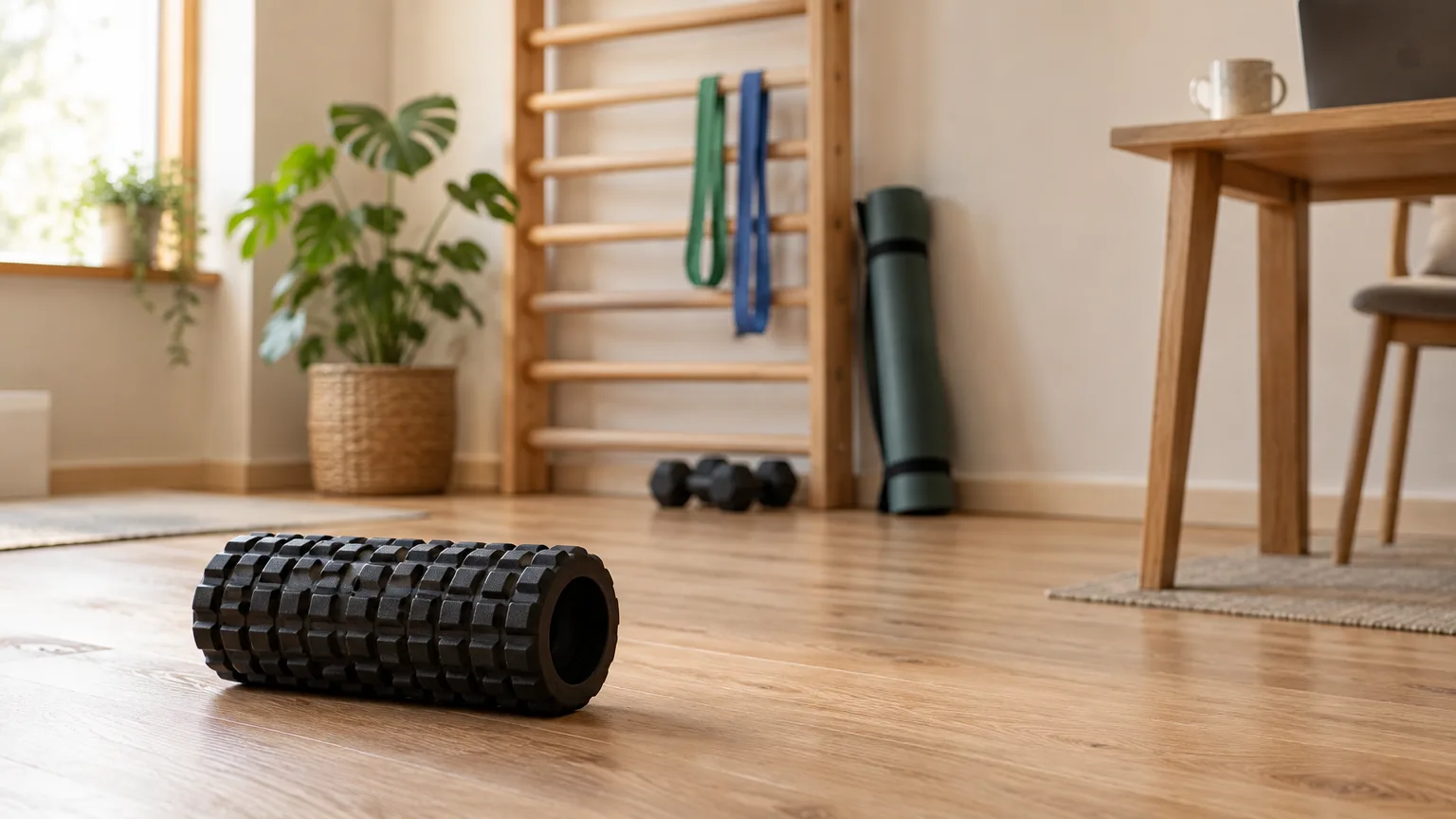
From my own experience: when my back aches, a leg starts to pull or my glutes hurt, a session on my fairly firm roller eases the pain for at least half an hour, and my body feels lighter. That's when I roll now and then.
And don't expect to just lie there: you hold yourself up on your arms and core, muscles you'd forgotten about wake up, and if you're out of shape you may even get a bit out of breath, like after a proper morning workout.
Once rolling and exercise became part of an ordinary day, I simply hurt less: each session gives a less dramatic lift, but it lasts longer, and I feel steady instead of up and down. The research describes the same pattern, by the way: a brief effect from one session, a lasting one from regular practice 310.
Your fascia isn't being ironed out
"Myofascial release" promises to smooth out knots in the tissue around your muscles. The tissue doesn't work that way. Compressing dense thigh fascia by even 1% would take far more force than a body can put through a roller 5. In cadaver tests the band along the outer thigh stretched under half a percent 6. A review of the mechanisms found no evidence of any "release" 7.
Your nerves are another story. Roll your left calf and the right one gets about 5.6% more flexible too 8. Nobody touched it. Rolling a pain-free calf also raised the pain threshold of a tender spot in the other leg 9. The brain reacts less to signals from the muscle and lets it stretch further.
What the research actually supports
- Right after. Range of motion improves about as much as with stretching 12. It fades within about 30 minutes 10, so roll right before you move.
- After a few weeks. A moderate, lasting gain, clearer for thighs and past 4 weeks 3. A month of hamstring rolling matched proper stretching in another trial 4.
- After a hard workout. About 6% less soreness next day 11, in line with two heavy-squat trials 1213.
- For back or neck pain. Honestly, the data are thin: a few small trials, modest effects 1415. Not a cure.
How hard, how long
Harder isn't better. Three pressures on the thigh gave the same gain 16, and half your maximum tolerable discomfort worked as well as full 17. A firm roller presses much harder than a soft one 18, so keep some weight on your hands.
- Pressure. "I feel it and still breathe normally." A clenched jaw means too much.
- Time. On calves, 30 seconds did little and 90 seconds did more 10. Guidance spans 30 to 120 seconds 17, so aim for a minute per side.
- Speed. Slow, about 2 to 4 seconds per pass in one direction 17.
The full-body routine, feet first
The "Foam roller release" set in WeaveMove covers 13 areas in order, from feet, calves and all four sides of the thigh up to the upper back, lats, chest and the forearms your mouse wore out. Each fits a 2-minute break. Three of them:
Calf roll
- Starting position. Sit with the roller under one calf, hands behind you.
- Action. Lift your hips and roll slowly from above the Achilles tendon to a hand's width below the knee.
- Result. The calf warms and the ankle bends more easily. Switch after a minute.
Upper back roll
- Starting position. On your back, roller under your shoulder blades, knees bent, hands behind your head.
- Action. Lift your hips and push with your legs, rolling down to your lowest ribs and back.
- Result. Shoulders open, breathing gets easier. Never go below the ribs.
Glute roll
- Starting position. Sit on the roller and cross your right ankle over your left knee.
- Action. Lean onto your right glute and roll in short strokes of 10 to 15 cm.
- Result. An even pressure in the muscle. Tingling down the leg means the sciatic nerve; shift sideways.
Where not to roll
- Lower back. No ribs protect the spine here. One study rolled it with benefit, but in healthy people on a soft roller with light pressure 19. We never put a firm roller there.
- Neck. We found no study of rolling it under body weight. Not a place to experiment.
- Back of the knee. An artery, a large vein and nerves run through it 20.
- Groin and armpit. Vessels, lymph nodes, nerves. Stop a hand's width short.
- Bones and joints. Kneecap, pelvic bones, tailbone, spine.
Who should check with a doctor first
Experts agreed that open wounds and fractures rule rolling out, while inflammation, deep vein thrombosis, bone infection and bone forming in a muscle after injury call for real caution 21. They couldn't agree on osteoporosis, varicose veins, blood thinners or pregnancy 21, and such people rarely appear in trials 17. If that's you, ask first.
When to see a doctor
- One leg, usually the calf, is swollen, warm, painful or red. Don't roll it: those are signs of a blood clot 22, and you need a doctor the same day. If you're also short of breath or have chest pain, call emergency services 22.
- Numbness, tingling or weakness that stays after you stop.
- Bruising after every session.
- More pain next morning than before, or sharp joint pain.
FAQ
Is foam rolling the same as myofascial release?
In practice, yes; the first just sounds more clinical. The roller changes how your nervous system reads the muscle, not the tissue itself 578.
Should foam rolling hurt?
No. Heavier pressure added nothing 1617. Some discomfort is fine; pain that makes you hold your breath isn't.
Keep the roller where you can see it, start tonight with your feet, and let WeaveMove remember the order of the other twelve.
Sources
- Wilke J, Müller AL, Giesche F, Power G, Ahmedi H, Behm DG. Acute effects of foam rolling on range of motion in healthy adults: a systematic review with multilevel meta-analysis. Sports Med. 2020;50(2):387–402. https://doi.org/10.1007/s40279-019-01205-7
- Konrad A, Nakamura M, Paternoster FK, Tilp M, Behm DG. A comparison of a single bout of stretching or foam rolling on range of motion in healthy adults. Eur J Appl Physiol. 2022. https://pubmed.ncbi.nlm.nih.gov/35298696/
- Konrad A, Nakamura M, Tilp M, Donti O, Behm DG. Foam rolling training effects on range of motion: a systematic review and meta-analysis. Sports Med. 2022;52(10):2523–2535. https://pmc.ncbi.nlm.nih.gov/articles/PMC9474417/
- Junker DH, Stöggl TL. The foam roll as a tool to improve hamstring flexibility. J Strength Cond Res. 2015;29(12):3480–3485. https://doi.org/10.1519/JSC.0000000000001007
- Chaudhry H, Schleip R, Ji Z, et al. Three-dimensional mathematical model for deformation of human fasciae in manual therapy. J Am Osteopath Assoc. 2008;108(8):379–390. https://doi.org/10.7556/jaoa.2008.108.8.379
- Falvey EC, Clark RA, Franklin-Miller A, et al. Iliotibial band syndrome: an examination of the evidence behind a number of treatment options. Scand J Med Sci Sports. 2010;20(4):580–587. https://pubmed.ncbi.nlm.nih.gov/19706004/
- Behm DG, Wilke J. Do self-myofascial release devices release myofascia? Rolling mechanisms: a narrative review. Sports Med. 2019;49(8):1173–1181. https://doi.org/10.1007/s40279-019-01149-y
- Konrad A, Nakamura M, Warneke K, Donti O, Gabriel A. The contralateral effects of foam rolling on range of motion and muscle performance. Eur J Appl Physiol. 2023;123(6):1167–1178. https://doi.org/10.1007/s00421-023-05142-2
- Aboodarda SJ, Spence AJ, Button DC. Pain pressure threshold of a muscle tender spot increases following local and non-local rolling massage. BMC Musculoskelet Disord. 2015;16:265. https://doi.org/10.1186/s12891-015-0729-5
- Nakamura M, Onuma R, Kiyono R, et al. The acute and prolonged effects of different durations of foam rolling on range of motion, muscle stiffness, and muscle strength. J Sports Sci Med. 2021;20(1):62–68. https://jssm.org/jssm-20-62.xml-Fulltext
- Wiewelhove T, Döweling A, Schneider C, et al. A meta-analysis of the effects of foam rolling on performance and recovery. Front Physiol. 2019;10:376. https://doi.org/10.3389/fphys.2019.00376
- Pearcey GE, Bradbury-Squires DJ, Kawamoto JE, et al. Foam rolling for delayed-onset muscle soreness and recovery of dynamic performance measures. J Athl Train. 2015;50(1):5–13. https://pubmed.ncbi.nlm.nih.gov/25415413/
- Macdonald GZ, Button DC, Drinkwater EJ, Behm DG. Foam rolling as a recovery tool after an intense bout of physical activity. Med Sci Sports Exerc. 2014;46(1):131–142. https://doi.org/10.1249/MSS.0b013e3182a123db
- Santos IS, Dibai-Filho AV, dos Santos PG, et al. Effects of foam roller on pain intensity in individuals with chronic and acute musculoskeletal pain: a systematic review of randomized trials. BMC Musculoskelet Disord. 2024;25:172. https://doi.org/10.1186/s12891-024-07276-6
- Wu Z, Wang Y, Ye X, et al. Myofascial release for chronic low back pain: a systematic review and meta-analysis. Front Med. 2021;8:697986. https://doi.org/10.3389/fmed.2021.697986
- Grabow L, Young JD, Alcock LR, et al. Higher quadriceps roller massage forces do not amplify range-of-motion increases nor impair strength and jump performance. J Strength Cond Res. 2018;32(11):3059–3069. https://pubmed.ncbi.nlm.nih.gov/30152808/
- Behm DG, Alizadeh S, Hadjizadeh Anvar S, et al. Foam rolling prescription: a clinical commentary. J Strength Cond Res. 2020;34(11):3301–3308. https://pubmed.ncbi.nlm.nih.gov/33105383/
- Curran PF, Fiore RD, Crisco JJ. A comparison of the pressure exerted on soft tissue by 2 myofascial rollers. J Sport Rehabil. 2008;17(4):432–442. https://doi.org/10.1123/jsr.17.4.432
- Fijavž J, Frangež M, Vauhnik R. Effects of lower back foam rolling on the pressure pain threshold and the range of motion of the lumbar spine in healthy individuals. Front Physiol. 2024;15:1476342. https://doi.org/10.3389/fphys.2024.1476342
- Varacallo MA. Anatomy, Bony Pelvis and Lower Limb: Popliteal Region. StatPearls (NCBI Bookshelf). https://www.ncbi.nlm.nih.gov/books/NBK532891/
- Bartsch KM, Baumgart C, Freiwald J, et al. Expert consensus on the contraindications and cautions of foam rolling: an international Delphi study. J Clin Med. 2021;10(22):5360. https://doi.org/10.3390/jcm10225360
- NHS. Deep vein thrombosis (DVT). https://www.nhs.uk/conditions/deep-vein-thrombosis-dvt/

Comments
No comments yet. Be the first to share your experience.