
Losing Weight With a Desk Job: What Actually Works
Want to lose weight with a desk job? What the research says: food does most of the work, movement protects muscle and health, plus 3 safe moves for your desk.
On this page
It's 4 pm, you've been on calls since ten, and the cookie tin on the shared shelf is half empty. If you want to lose weight with a desk job, start with your plate: a calorie deficit you can keep up for months matters far more than which diet you pick or how much you train 124. Movement adds a little extra loss and helps your heart, and strength work protects muscle 456. Aim for a steady 0.5–1 kg (1–2 lb) a week 910.
Food does most of the work
In a meta-analysis of 48 trials, low-carb and low-fat diets both took off about 7 kg at 12 months, and named diets differed little 1. The DIETFITS trial in 609 adults agreed: 6.0 kg versus 5.3 kg after a year, no significant difference 2.
The best diet is the one you'll still be on in March.
What you eat still affects how much you eat. In one month-long inpatient trial, 20 people ate about 500 kcal a day more on an ultra-processed menu than on an unprocessed one 3. One small study, but anyone who has met office donuts will recognize it. Filling options: Healthy desk snacks that actually keep you full.
Even a 5% loss can improve blood pressure, cholesterol and blood sugar 10.
Where exercise fits
Honestly? In a Cochrane review, adding exercise to a diet gave only about 1 kg more loss than the diet alone 4. The American College of Sports Medicine calls the loss from 150–250 minutes a week of moderate activity modest; over 250 minutes is linked with bigger loss and better maintenance, mostly in observational data 5.
Keep the walks anyway: in the same review, exercise lowered blood pressure, triglycerides and fasting blood sugar even when people lost no weight 4.
Strength work protects muscle. It doesn't speed up weight loss, but it may help you keep lean mass 5. In a meta-analysis of six trials in adults over 57, adding resistance training to a diet prevented almost all the muscle loss the diet alone caused 6. In younger people it's less tested.
WHO recommends 150–300 minutes of moderate activity a week, strength work on two or more days, and less sitting 7.
Moving more at the desk
We counted everyday-movement calories in NEAT at a desk job: a standing desk burns very little, walking does more. Walk after lunch, too. Light walking breaks lowered blood sugar and insulin after meals more than standing breaks, though in one-day lab trials 8.
Three moves for between calls. One round today; add a second after a week or two if it feels easy.
Chair sit-to-stand
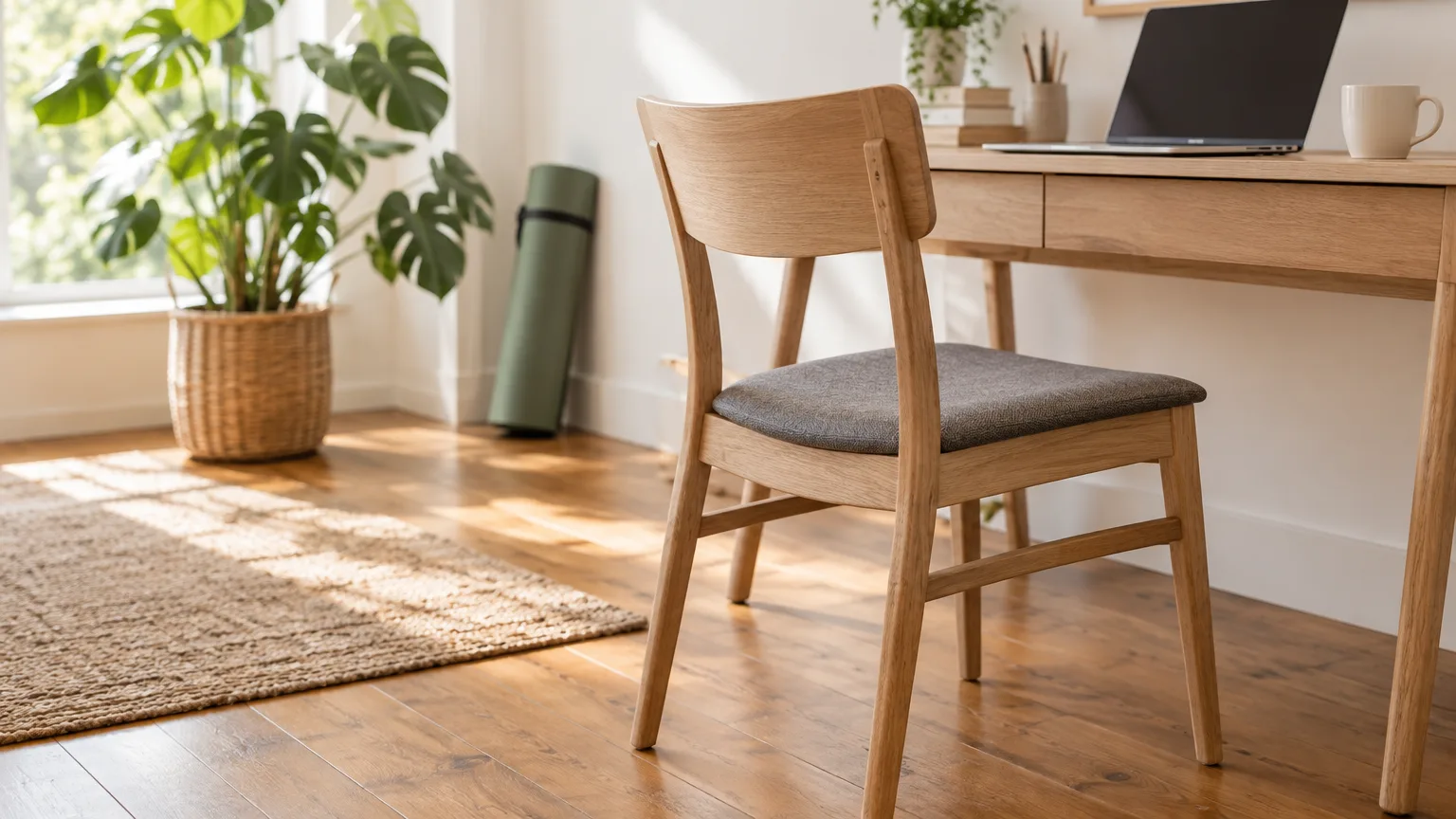
- Starting position: front edge of a sturdy chair without wheels, feet flat, arms crossed.
- Action: lean forward with a straight back and stand up; sit back down slowly, over about 3 seconds.
- Result: your thighs and glutes feel warm and working.
- Safety: 8–10 reps, building to 15; use the armrests if your knees grumble. Skip after recent knee or hip surgery unless your physio agrees. Stop with sharp knee pain or dizziness.
Desk push-ups
- Starting position: hands on the edge of a sturdy desk, a little wider than your shoulders; step back until your body is straight from head to heels.
- Action: lower your chest toward the desk over 2 seconds, elbows angled back about 45 degrees, then push up.
- Result: chest, shoulders and arms work; your belly keeps you straight.
- Safety: 6–10 reps, feet close at first; stepping back makes it harder. Never a desk on wheels. Skip with a shoulder or wrist injury; stop if either hurts.
March in place
- Starting position: stand tall, feet hip-width apart, elbows bent.
- Action: lift one knee, then the other, swinging the opposite arm, about two steps a second.
- Result: you breathe a bit faster and your legs wake up.
- Safety: 30–60 seconds; quiet enough for an open office. Stop with chest pain, dizziness or unusual breathlessness.
Heart or joint problems, or years without exercise? Check with your doctor first. More moves: Bodyweight strength at your desk.
When to see a doctor
- You have diabetes, heart disease or take regular medicines; a GP can advise on safe weight loss 9.
- You're considering a very low calorie diet. The NHS says these aren't safe for everyone 9.
- You keep losing weight without trying 12.
- You think about food and body shape all the time, skip meals, make yourself sick or exercise to "make up" for eating, or weight is dropping fast. These can be signs of an eating disorder; see a GP soon 11.
Start with tomorrow's lunch
Nobody gets slim from five sit-to-stands. Do them now anyway, pack tomorrow's lunch tonight, and let WeaveMove remind you to get up between calls.
FAQ
Can you lose weight with a desk job without a gym?
Yes. Weight loss comes mainly from eating less than you burn 12.
How fast should you lose weight?
About 0.5–1 kg (1–2 lb) a week. CDC notes that people who lose at this pace are more likely to keep it off 910.
Does strength training help you lose weight?
It barely moves the scale but helps keep muscle 56.
Sources
- Johnston BC, Kanters S, Bandayrel K, et al. Comparison of weight loss among named diet programs in overweight and obese adults: a meta-analysis. JAMA. 2014;312(9):923–933. https://doi.org/10.1001/jama.2014.10397
- Gardner CD, Trepanowski JF, Del Gobbo LC, et al. Effect of low-fat vs low-carbohydrate diet on 12-month weight loss in overweight adults and the association with genotype pattern or insulin secretion: the DIETFITS randomized clinical trial. JAMA. 2018;319(7):667–679. https://doi.org/10.1001/jama.2018.0245
- Hall KD, Ayuketah A, Brychta R, et al. Ultra-processed diets cause excess calorie intake and weight gain: an inpatient randomized controlled trial of ad libitum food intake. Cell Metab. 2019;30(1):67–77.e3. https://doi.org/10.1016/j.cmet.2019.05.008
- Shaw KA, Gennat HC, O'Rourke P, Del Mar C. Exercise for overweight or obesity. Cochrane Database Syst Rev. 2006;(4):CD003817. https://doi.org/10.1002/14651858.CD003817.pub3
- Donnelly JE, Blair SN, Jakicic JM, et al; American College of Sports Medicine. Appropriate physical activity intervention strategies for weight loss and prevention of weight regain for adults. Med Sci Sports Exerc. 2009;41(2):459–471. https://doi.org/10.1249/MSS.0b013e3181949333
- Sardeli AV, Komatsu TR, Mori MA, Gáspari AF, Chacon-Mikahil MPT. Resistance training prevents muscle loss induced by caloric restriction in obese elderly individuals: a systematic review and meta-analysis. Nutrients. 2018;10(4):423. https://doi.org/10.3390/nu10040423
- Bull FC, Al-Ansari SS, Biddle S, et al. World Health Organization 2020 guidelines on physical activity and sedentary behaviour. Br J Sports Med. 2020;54(24):1451–1462. https://doi.org/10.1136/bjsports-2020-102955
- Buffey AJ, Herring MP, Langley CK, Donnelly AE, Carson BP. The acute effects of interrupting prolonged sitting time in adults with standing and light-intensity walking on biomarkers of cardiometabolic health in adults: a systematic review and meta-analysis. Sports Med. 2022;52(8):1765–1787. https://doi.org/10.1007/s40279-022-01649-4
- NHS. Obesity: treatment. https://www.nhs.uk/conditions/obesity/treatment/
- Centers for Disease Control and Prevention. Losing weight. https://www.cdc.gov/healthy-weight-growth/losing-weight/index.html
- NHS. Eating disorders: overview. https://www.nhs.uk/mental-health/feelings-symptoms-behaviours/behaviours/eating-disorders/overview/
- NHS. Unintentional weight loss. https://www.nhs.uk/symptoms/unintentional-weight-loss/
Comments
No comments yet. Be the first to share your experience.